
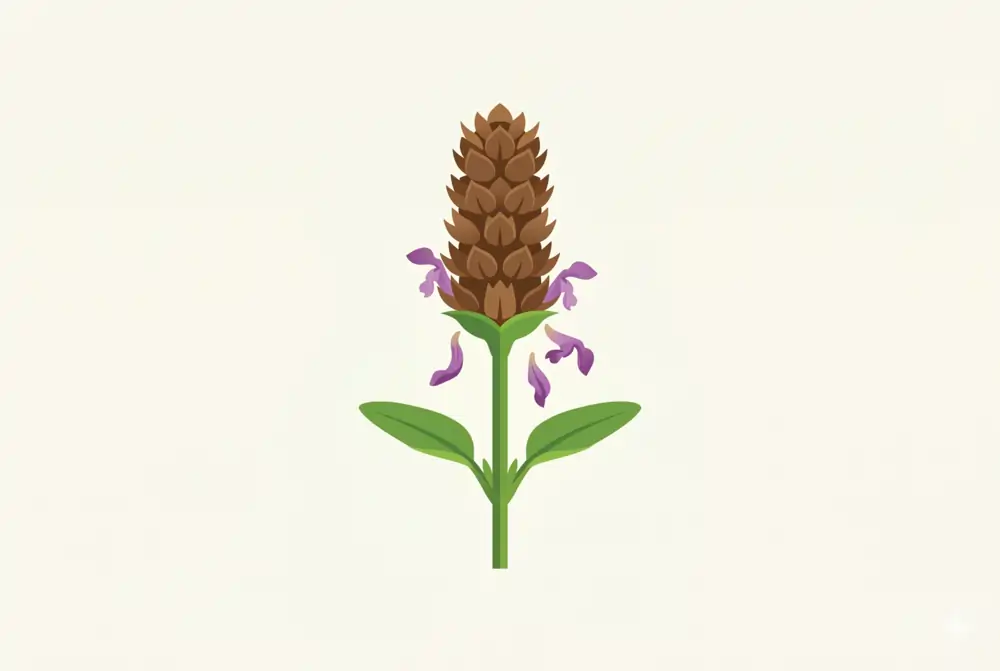
Why Self-Heal Flower Spikes Turn Brown is a common identification question after the bright purple flowers of Prunella vulgaris begin to fade. The compact flower head may become tan or brown while remaining upright on the stem for weeks. This seasonal change is usually part of normal flowering and seed development, not proof that the plant has become a different species.
Self-Heal is easiest to notice while its purple, violet, or blue-purple flowers are open. Once those petals disappear, the persistent brown spike can look like dead grass, damaged material, or an unfamiliar weed. Secrets Of The Tribe treats seasonal appearance as an important botanical clue: a plant should be identified through several stable features, not flower color alone.
This article explains what happens to the flower spike after blooming, why the brown structure remains attached, and which features still support identification. It is not a foraging or harvesting guide. Do not consume a wild plant based only on a photograph, flower head, or common name.
Why Do Self-Heal Flower Spikes Turn Brown?
Self-Heal flower spikes turn brown as flowering ends and the remaining floral structures dry.
The colorful petals are temporary. After pollination, they wilt and fall away. The denser bracts, calyxes, and supporting parts of the flower head remain. As these structures lose moisture and mature, they shift from green or purple-green to tan, reddish-brown, or dark brown.
This color change is a normal part of the plant’s seasonal cycle.
What Changes Inside the Flower Spike?
The visible flower spike contains more than petals.
Prunella vulgaris produces small flowers within overlapping bracts and persistent calyx structures. The petals create most of the bright purple color during bloom. Once flowering finishes, the tougher supporting structures remain around the developing fruits.
Those persistent parts create the dry, compact brown head seen later in the season.
Self-Heal Flower Spike Through the Season
| Seasonal Stage | Typical Appearance | What Is Happening |
|---|---|---|
| Early bud stage | Compact green or purple-green head | Flowers are forming inside the bracts |
| Active flowering | Purple or violet flowers emerge from the spike | Flowers open in sections of the head |
| Late flowering | Fewer fresh flowers and more faded sections | Older petals drop while later flowers may remain |
| Seed development | Spike becomes tan or brown | Persistent floral parts dry around developing fruits |
| Old seed-head stage | Dry brown spike remains on the stem | Seeds may disperse while the structure persists |
Why Does the Brown Flower Head Stay on the Plant?
The brown head stays because its bracts and calyxes are firmer and more persistent than the petals.
Petals are delicate structures designed for a limited flowering period. The supporting flower parts remain attached after the petals fall. They protect the developing fruits and give the mature head its dry, layered appearance.
Wind, rain, mowing, trampling, and seasonal decay eventually break the old spike down.
Does a Brown Spike Mean the Plant Is Dead?
No. A brown flower spike does not mean the whole Self-Heal plant is dead.
The flowering head can dry while the leaves and creeping stems remain green. Prunella vulgaris is a perennial in many climates, so its above-ground growth may continue, become partly dormant, or return from established crowns and rooting stems.
Judge the entire plant rather than one finished flower head.
Does Browning Mean the Plant Is Diseased?
Normal browning after flowering is not the same as disease.
A mature seed head usually dries evenly and keeps its recognizable compact form. Disease or severe damage may involve spreading leaf spots, soft tissue, unusual discoloration, collapsed stems, fuzzy growth, or widespread decline unrelated to normal flowering.
A dry brown spike above otherwise stable foliage usually fits seasonal maturity.
How Can You Tell Normal Browning From Damage?
| Observation | Normal Seasonal Change | Possible Damage or Decay |
|---|---|---|
| Flower head color | Even tan, brown, or reddish-brown | Blackened, slimy, or irregularly discolored |
| Texture | Dry and firm | Soft, wet, collapsing, or fuzzy |
| Leaves | May remain green below the spike | May show extensive spotting or sudden collapse |
| Stem | Still structured and attached | Broken, mushy, or severely damaged |
| Timing | Appears after flowering | May appear suddenly before normal bloom ends |
Why Do Purple Flowers Disappear Before the Spike Does?
The purple petals and the spike have different functions and lifespans.
Petals help attract pollinators during the active flowering period. They are no longer needed after the flower matures, so they wilt and detach. The calyx and bracts remain because they support and surround the developing fruit.
The brown head is therefore the framework left after the showier flower parts are gone.
Why Can One Spike Look Purple and Brown at the Same Time?
Self-Heal flowers may not all open or finish on the same day.
One section of the spike can still hold fresh purple flowers while another section has already dried. This creates a mixed appearance with purple petals, green bracts, faded flowers, and brown areas on the same head.
That uneven transition is common during late flowering.
What Does a Mature Self-Heal Seed Head Look Like?
A mature seed head is usually short, dense, and cylindrical or slightly club-shaped.
It may appear tan, medium brown, reddish-brown, or dark brown. The overlapping bracts can give it a layered or scaled look. The head often remains at the top of a square or four-angled stem.
Its shape is usually more useful than its exact shade of brown.
Do Brown Spikes Still Contain Seeds?
They may contain mature or developing fruits, especially before full dispersal.
Members of the mint family commonly produce small nutlet-like fruits after flowering. As the structure dries, these fruits mature and may later fall from the persistent calyx.
An empty old spike can remain attached even after much of the seed has dispersed.
Why Does the Spike Look Like a Tiny Pine Cone?
The overlapping bracts create a compact layered pattern.
After the soft petals disappear, the firmer bracts become more visible. Their arrangement can make the dry head resemble a tiny cone, hop-like structure, or brown scale-covered cylinder.
This compact persistent head is one useful feature when observing Self-Heal after flowering.
Can Self-Heal Be Identified Without Purple Flowers?
It can sometimes be recognized after flowering, but identification becomes less certain.
Useful traits include opposite leaves, square stems, low spreading growth, short dense flower heads, and persistent brown spikes. The leaves may be oval, oblong, or lance-shaped, depending on growth conditions and position on the plant.
No single trait should be used alone, especially when the plant will be handled or consumed.
Which Features Remain Useful After Flowering?
The plant’s structure often remains more stable than its flower color.
Opposite Leaves
Leaves commonly grow in pairs on opposite sides of the stem, a pattern frequently seen in the mint family.
Square or Angled Stems
The stems may feel four-sided rather than round, although this trait is not exclusive to Prunella vulgaris.
Low Spreading Growth
Self-Heal often grows close to the ground and may form patches in lawns, meadows, paths, and disturbed soil.
Compact Persistent Heads
The old flower heads remain short and dense rather than becoming loose, feathery, or widely branched.
Why Is Flower Color Alone Unreliable?
Flower color changes with age, light, weather, moisture, and individual plant variation.
Fresh flowers may appear blue-purple, violet, lavender, or deep purple. Fading flowers can become dull, pale, reddish, or brown. Photographs can also distort color through lighting and camera settings.
Reliable identification requires shape, leaf arrangement, stem structure, growth habit, and botanical context.
Why Do Lawn Plants Look Different After Mowing?
Mowing can remove the taller stems and fresh flowers while leaving lower growth or shortened brown heads.
Prunella vulgaris often tolerates close mowing because of its low habit. It may produce shorter flower stems in regularly cut turf than in a meadow or unmown garden bed.
This can make lawn Self-Heal look more compact and less obvious than plants growing in taller vegetation.
Why Do Some Brown Spikes Remain Through Winter?
Dry plant structures break down at different rates.
In sheltered or dry conditions, an old spike may remain upright after leaves decline. In wetter, windier, or heavily trafficked areas, it may collapse sooner. Snow, frost, mowing, and foot traffic also affect persistence.
A winter-brown spike may be last season’s flower head rather than current growth.
Can New Growth Appear Below an Old Brown Spike?
Yes. Fresh green leaves or shoots may grow near stems carrying old heads.
Perennial plants do not replace every structure at the same moment. One part can remain dry while another part continues vegetative growth or begins a new seasonal cycle.
This mixed old-and-new appearance is normal in established patches.
Does a Brown Flower Spike Mean the Material Is Ready to Use?
No. Flower color does not establish suitability, cleanliness, identity, quality, or serving information.
A brown lawn plant may have unknown exposure to herbicides, fertilizers, roadside residue, pets, wildlife, runoff, or soil contaminants. Seasonal maturity does not remove those source concerns.
This article does not provide collection or preparation instructions.
Why Commercial Self-Heal May Not Look Purple
Dried Prunella vulgaris products often lose much of the fresh plant’s bright color.
Cut herb, powder, tea material, and capsule contents may appear olive, green-brown, tan, or dark herbal green. Drying, grinding, storage, plant part, and harvest stage all affect color.
A commercial product should be evaluated through its label, botanical identity, plant part, lot number, storage condition, and quality documentation.
Why Product Form Changes Appearance
A fresh flower spike, dried aerial herb, fine powder, tincture, and capsule are visually different forms.
A capsule cannot preserve the recognizable shape of the purple flower head. Powder blends leaves, stems, flowers, and other declared plant material into a uniform texture.
Secrets Of The Tribe takes a cautious editorial position here: field appearance helps explain the plant, but finished-product identity should depend on label details and batch documentation.
When Should Brown Plant Material Raise Concern?
Brown color alone is not enough to identify a problem because mature plant structures naturally turn brown.
Concern is more appropriate when material is wet, slimy, moldy, unusually spotted, chemically scented, rotten-smelling, or visibly contaminated. Commercial dried herb should remain consistent with the product description and storage instructions.
Do not taste or smell suspicious material closely to determine whether it is safe.
Why Source Still Matters After Identification
Correctly identifying Prunella vulgaris does not establish that a particular plant is suitable as an ingredient.
Source history includes chemical treatments, soil conditions, nearby roads, animal activity, water quality, harvest handling, drying, storage, and contamination controls. A brown spike provides no information about those factors.
Botanical identity and source quality must be evaluated separately.
Why Self-Heal Changes Can Confuse Beginners
Many field photos show Self-Heal only at peak bloom.
A beginner may learn to expect bright purple flowers and overlook the same plant when the petals fall. The compact brown seed head can then appear unrelated, especially if mowing has changed the plant’s height.
Learning the full seasonal sequence makes identification more accurate.
Self-Heal Brown Flower Spike Checklist
Use this checklist when purple Self-Heal flowers have disappeared and only brown heads remain. It helps you compare seasonal features without relying on color alone.
Check the Timing
Brown spikes appearing after purple flowering often fit normal seasonal maturity.
Look at the Head Shape
Self-Heal usually keeps a short, dense, layered spike rather than a loose branching seed head.
Inspect the Texture
A mature spike is usually dry and firm, not slimy, soft, or fuzzy.
Check the Leaves
Look for opposite leaf pairs along low-growing or partly upright stems.
Feel the Stem Shape
The stem may be square or four-angled, but this trait should not be used alone.
Observe the Growth Habit
Prunella vulgaris often grows low and spreading in turfgrass, paths, meadows, and disturbed ground.
Compare More Than One Feature
Use flower-head shape, leaves, stems, growth habit, and seasonal timing together.
Separate Identity From Suitability
Correct identification does not establish that a lawn or roadside plant is suitable for consumption.
Ask an Expert When Uncertain
Use a qualified botanist, local extension service, or herbarium for identification support.
Common Mistakes to Avoid
Assuming the Brown Head Is a Different Plant
The brown spike may be the persistent flower structure of the same Prunella vulgaris plant.
Assuming the Whole Plant Is Dead
The flower head can dry while lower leaves and spreading stems remain alive.
Using Purple Color as the Only Identifier
Flower color disappears after bloom and varies between plants and photographs.
Confusing Normal Drying With Mold
A normal seed head is dry and firm, while mold or decay may look fuzzy, wet, or collapsed.
Treating Identification as Permission to Consume
Species identification does not address herbicides, soil history, roadside exposure, or contamination.
FAQ
Why do Self-Heal flower spikes turn brown?
The petals fall after flowering, while persistent bracts and calyxes dry around the developing fruits.
Is a brown Self-Heal flower head normal?
Yes. A dry brown head is a normal stage after the purple flowers fade.
Does a brown spike mean Self-Heal is dead?
No. The flower head can dry while leaves, roots, and spreading stems remain alive.
Why does the brown spike stay attached?
The firm supporting flower structures persist longer than the delicate petals.
Can Self-Heal be identified after flowering?
Sometimes. Use the compact brown head, opposite leaves, angled stems, and low growth habit together.
What does a mature Self-Heal seed head look like?
It is usually short, dense, dry, layered, and tan to dark brown.
Can purple and brown appear on the same flower spike?
Yes. Different flowers on the spike may mature at different times.
Do old brown Self-Heal heads contain seeds?
They may contain developing or mature fruits, although empty heads can remain after dispersal.
Is a brown spike a sign of disease?
Not by itself. Normal mature spikes are dry and firm, while diseased tissue may be soft, wet, fuzzy, or collapsing.
Can brown lawn Self-Heal be used as an ingredient?
Brown color does not establish identity, cleanliness, source quality, or suitability for consumption.
Glossary
Self-Heal – A common name for Prunella vulgaris, a low-growing perennial in the mint family.
Flower spike – A compact flower cluster arranged along a central axis.
Bract – A modified leaf positioned near or around a flower.
Calyx – The outer flower structure formed by sepals, which may remain after petals fall.
Pollination – The transfer of pollen that allows seed-producing structures to develop.
Seed head – The mature flower structure that remains as fruits or seeds develop and disperse.
Nutlet – A small dry fruit commonly produced by plants in the mint family.
Persistent – Remaining attached after other plant parts have fallen.
Perennial – A plant that can live for more than two growing seasons.
Lamiaceae – The mint family, which includes Prunella, Mentha, basil, sage, rosemary, and many other plants.
Conclusion
Self-Heal flower spikes turn brown because the petals disappear while the supporting floral structures dry and remain around the developing fruits. The persistent brown head can help with seasonal identification, but it should be evaluated alongside leaves, stems, growth habit, and source context.
Sources
Accepted botanical identity and taxonomic record for Prunella vulgaris, Plants of the World Online – powo.science.kew.org/taxon/urn:lsid:ipni.org:names:454640-1
Prunella vulgaris plant description, flower structure, growth habit, and seasonal appearance, North Carolina Extension Gardener Plant Toolbox – plants.ces.ncsu.edu/plants/prunella-vulgaris
Self-Heal identification, flowering characteristics, and horticultural profile, Missouri Botanical Garden – missouribotanicalgarden.org/PlantFinder/PlantFinderDetails.aspx
Prunella vulgaris botanical record and geographic distribution, USDA Plants Database – plants.usda.gov/home/plantProfile
Self-Heal species description and flowering morphology, Illinois Wildflowers – illinoiswildflowers.info/lawns/plants/self_heal.htm
Mint-family flower and fruit terminology, Encyclopaedia Britannica – britannica.com/plant/Lamiales
Botanical terminology for flowers, fruits, bracts, and persistent structures, University of Florida IFAS Extension – gardeningsolutions.ifas.ufl.edu
Self-Heal botanical overview and common-name context, Encyclopaedia Britannica – britannica.com/plant/self-heal

Cassia Rowley is the mastermind behind advertising at The Bad Pod. She blends creativity with strategy to make sure ads on our site do more than just show up—they spark interest and make connections. Cassia turns simple ad placements into engaging experiences that mesh seamlessly with our content, truly capturing the attention of our audience.