
It is late. An idea lingers without structure—recognizable, but not yet audible. There is not enough certainty to justify opening a full production session, and not enough clarity to let the idea go.
This is where many musical ideas stall. Not because they lack potential, but because the effort required to hear them feels disproportionate to what is known so far. Silence offers no evidence. Guesswork fills the gap.
At this stage, the need is modest but specific: a way to hear something before deciding whether it deserves further time. Musick AI enters precisely at this moment. An AI Music Generator here does not promise completion. It offers a checkpoint—sound as a basis for judgment.
The pressure is rarely about creativity alone.
It is about whether the next step is justified.
I. What Is Musick AI?
Musick AI sits in a narrow band of the music creation process. It does not initiate ideas, and it does not finalize them. Its role appears after an idea exists, but before a commitment has been made.
This is an interim stage. A threshold where abstraction becomes sound, but intent remains flexible.
At this point, the central question is not quality. It is viability. Hearing an idea, even in a provisional form, changes how it is evaluated. Musick AI enables that transition without demanding the full weight of production decisions.
Its scope is intentionally constrained. It does not refine, polish, or resolve. What it provides is temporary structure—enough to listen, enough to react. The reaction determines whether the idea moves forward or stops.
In this sense, the tool does not replace creative judgment. It creates the conditions for it to occur earlier.
II. What Musick AI Can Do
Musick AI supports a limited set of actions, each tied to making an idea audible rather than complete.
It can turn text descriptions into music when an idea exists more clearly in language than in notes. It can generate instrumental tracks when vocals are unnecessary or would interfere with context. It allows basic shaping of mood and structure so direction can be tested without fine control. It also supports multiple music genres, making it possible to check whether an idea fits a particular stylistic frame.
None of these functions aim to finalize a piece. Their shared purpose is to produce something that can be heard, assessed, and either continued or abandoned.
III. How to Use Musick AI Step by Step
Step 1 Turn an idea into an input
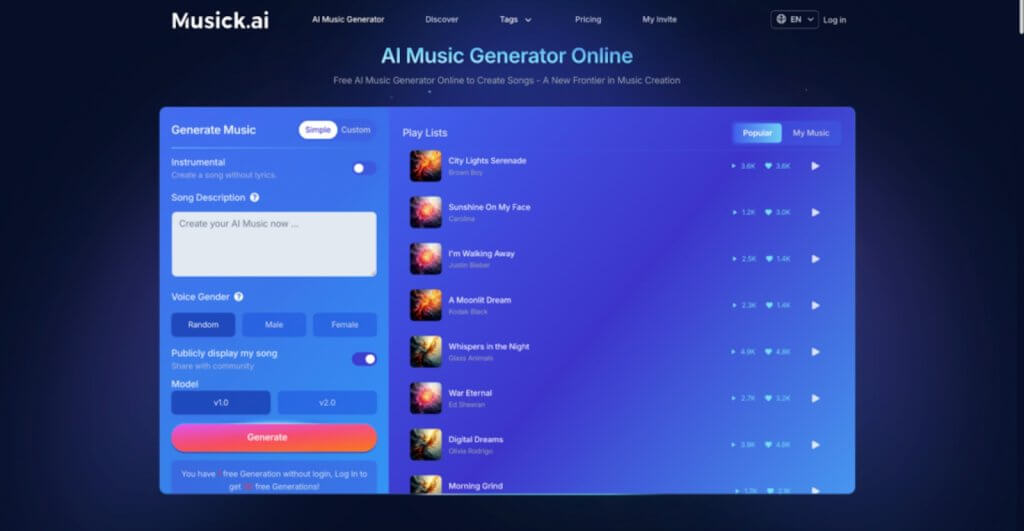
The process begins on the generation screen, where the idea is expressed either as a short description or as written lyrics. At this point, completeness is unnecessary. The input only needs enough clarity to become audible.
Step 2 Define the role of the output
Before generation, a decision is made about whether the result should include vocals or remain instrumental. This choice sets the listening context and clarifies how the music will function.
Step 3 Generate and listen
After selecting the available model version, the track is generated and played through once. The goal is recognition rather than evaluation. This step often happens through an AI Music Maker when opening a full production environment would be premature.
Step 4 Decide what happens next
When the track ends, the decision follows. The idea may move forward, change direction, or stop entirely. The tool’s role ends here; the judgment does not.
IV. What Musick AI Still Can’t Do
There are clear limits at this stage.
Emotional control remains broad rather than precise. Personal stylistic identity has observable boundaries. Final creative decisions still require human involvement.
These constraints are not shortcomings. They define where the tool stops and where deliberate creation begins.
V. What Changes When Sound Comes Earlier
| Dimension | Traditional Music Production | Musick AI Model |
| Time-to-Market | Evaluation follows setup | Evaluation occurs earlier |
| Technical Barriers | Tools required at the start | Minimal entry at idea stage |
| Creative Friction | High before sound exists | Lower before judgment |
| Capital Investment | Upfront commitment | Deferred until direction is clear |
VI. Conclusion
Creative tools matter most when they change when decisions are made. Musick AI shifts judgment closer to the idea itself.
Not to finish faster.
But to decide sooner.

Cassia Rowley is the mastermind behind advertising at The Bad Pod. She blends creativity with strategy to make sure ads on our site do more than just show up—they spark interest and make connections. Cassia turns simple ad placements into engaging experiences that mesh seamlessly with our content, truly capturing the attention of our audience.