
You have spent the last three days in a creative fugue state. The color grading on your video is impeccable. The copy on your landing page is sharp enough to cut glass. You have obsessively tweaked the pacing, the transitions, and the visual hierarchy. You are hovering over the “Export” button, ready to share your work with the world.
But then, you put your headphones on for one final check, and your heart sinks.
The audio. It is… fine. It is that same upbeat, ukulele-driven corporate background track that you have heard in five other commercials this week. Or perhaps it is a generic electronic beat that feels like it was bought by the yard.
Suddenly, your unique vision feels borrowed. You have built a Ferrari, but you are powering it with a lawnmower engine.
For years, this was the creator’s curse. We were visual masters but audio beggars. We were forced to scavenge through endless libraries of stock music, hoping to find something that didn’t sound like elevator filler. But the era of scavenging is over. We are entering the era of architectural sound.
The 3 AM Stock Music Fatigue
I know this pain intimately. Last month, I was editing a short documentary about urban decay—a project filled with slow, haunting shots of abandoned factories. I needed a soundtrack that sounded like “rust and memory.”
I spent four hours on a premium stock music site. I listened to 300 tracks tagged “sad” or “industrial.”
- Track 1 was too dramatic.
- Track 2 sounded like a horror movie trailer.
- Track 3 was perfect, but it was three minutes too short and ended abruptly.
I was trying to force a square peg into a round hole. I was letting the limitations of a library dictate the emotion of my art. This is the “Stock Music Trap”: you compromise your vision because you can only choose from what already exists.
Breaking the Mold: From Consumer to Conductor
This frustration is what drove me to explore the bleeding edge of generative audio. I wasn’t looking for a shortcut; I was looking for control. When I finally logged into the interface at AIsong AI, I realized I wasn’t just looking at a tool; I was looking at a way out of the trap.
The shift here is fundamental. It is the difference between buying a suit off the rack at a department store and having a tailor measure your inseam, choose the fabric, and stitch the garment around your specific posture.

The “Chef” Analogy
Think of traditional music licensing like ordering takeout. You get what is on the menu. If you don’t like cilantro, too bad—it’s already mixed in.
Generative AI transforms you into the Chef. You have access to the raw ingredients—tempo, mood, instrumentation, lyrics—and you decide the flavor profile. If you want a “spicy” Latin beat mixed with “cold” Nordic synthesizers, you don’t have to hope someone else cooked it up years ago. You simply order it into existence.
A Real-World Test: The “Haunted Cooking Show”
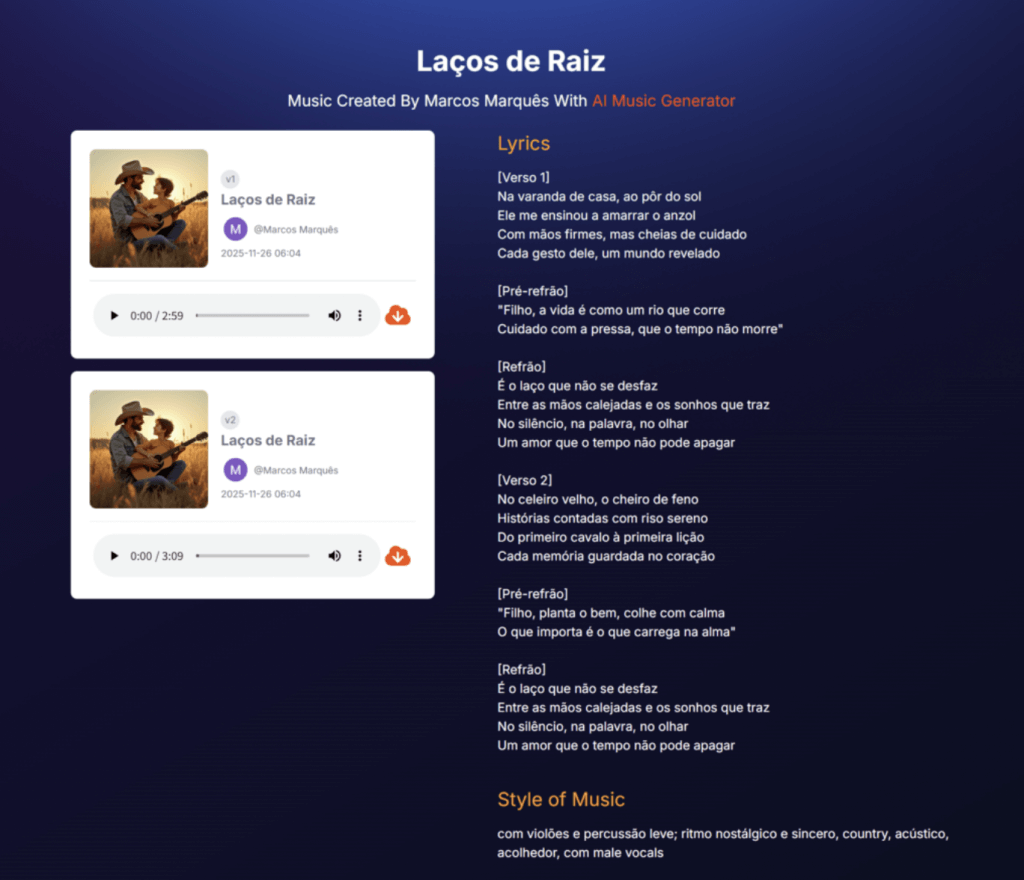
To prove to myself that this wasn’t just hype, I devised a prompt that I knew no stock library would have. I wanted to create a theme song for a fictional YouTube channel: a cooking show set in a haunted Victorian mansion.
The requirements were absurd:
- Genre: Upbeat 1950s TV commercial jingle.
- Twist: Underlying eerie, dissonant violin screeches.
- Lyrics: A cheerful recipe for “Ghostly Soufflé.”
In the old world, I would have had to hire a composer, a singer, and a sound designer. It would have cost thousands of dollars and taken weeks.
I typed the prompt into the AI engine. I pasted my ridiculous lyrics.
Forty seconds later, I was listening to exactly what I had imagined. The AI nailed the cheerful, sterile optimism of the 1950s vocals, but it perfectly wove in the unsettling, horror-movie strings underneath. It was funny, creepy, and completely unique. It was a “Purple Cow”—something remarkable that stands out in a field of brown cows.
The Economics of Uniqueness: A Visual Breakdown
Why does this matter for your brand or your content? Because we are drowning in noise. To stand out, you cannot sound like everyone else.
Let’s look at the stark contrast between the traditional “Hunting” method and the new “Harvesting” method of audio acquisition.
| Comparison Metric | The “Stock Library” Hunt | The AI Generative Approach |
| The Process | Passive Searching (Listening to hundreds of files) | Active Creating (Describing your vision) |
| Customization | Zero. You get what you get. | Infinite. Adjust tempo, key, and lyrics. |
| Exclusivity | Low. Your competitor might use the same track. | High. Your audio DNA is unique to you. |
| Lyric Integration | Impossible. Instrumental only. | Seamless. Your brand message is the song. |
| Emotional Fit | “Close enough” (Compromise) | “Exact match” (Precision) |
| Cost Efficiency | Pay per track or expensive monthly fees. | Generate hundreds of ideas for pennies. |
The Copyright Safety Net
There is a darker side to the creator economy that we need to address: the copyright strike.
We have all seen it happen. A YouTuber uses a “royalty-free” track, and three years later, the license changes, or a bot flags the video, and their monetization vanishes overnight. It is a sword of Damocles hanging over every creator’s head.
When you generate music using these advanced AI engines, you are stepping out of that danger zone. You are creating a new asset. You aren’t borrowing a melody that is registered in a massive database; you are birthing a new waveform. This offers a level of security and asset ownership that is becoming essential for anyone building a long-term brand.
How to Direct the Orchestra
If you are ready to stop searching and start creating, you need to understand that your role has changed. You are no longer a “music supervisor.” You are a Director.
Here is how to get the best performance out of your digital orchestra:
1. Speak in Textures, Not Just Genres
Don’t just say “Hip Hop.” That is too broad. Is it “dusty, lo-fi, vinyl-crackle Hip Hop”? or is it “aggressive, bass-heavy, trap Hip Hop”? The AI craves texture. Use sensory words like “shimmering,” “gritty,” “underwater,” or “hollow.”
2. The Narrative Arc
Think about the story your audio needs to tell. If you are making a product reveal video, you don’t want the energy to be flat.
- Prompt Tip: Ask for a “slow build-up intro” that transitions into a “high-energy, triumphant drop.” The AI understands structure. It can build the tension for you.
3. The Power of Contrast
The most interesting art comes from friction. Try combining opposing concepts. “A lullaby played on a distorted electric guitar.” “A heavy metal drum beat with a flute melody.” These combinations stop the scroll. They make the listener pause and say, “Wait, what is that?”
Conclusion: Your Vision, Uncompromised
We are living through a rare moment in technological history where the tools of the elite are being handed to the masses. The ability to score a film, write a ballad, or brand a business with proprietary audio is no longer defined by your budget. It is defined by your imagination.
Do not let your visuals do all the heavy lifting. Do not let a generic soundtrack dilute the power of your message.
The studio is empty, and the instruments are waiting. You have the vision. Now, you finally have the voice. Go to the platform, type in your wildest idea, and listen to the future of your creativity.

Cassia Rowley is the mastermind behind advertising at The Bad Pod. She blends creativity with strategy to make sure ads on our site do more than just show up—they spark interest and make connections. Cassia turns simple ad placements into engaging experiences that mesh seamlessly with our content, truly capturing the attention of our audience.